Political psychology
Opis
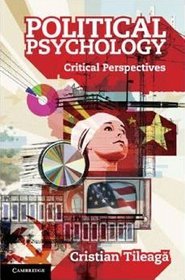
This book provides an introduction to political psychology through a focus on European politics and topics. It describes a style of doing political psychology in Europe that has developed out of dialogue with as well as critique of North American approaches. By emphasising the theoretical and methodological diversity of political psychology, the book is intended to contribute to a greater understanding of the strength and utility of the field.
"Cristian Tileaga's impressive new book offers an exciting new vision for political psychology. Moving beyond individualistic paradigms that dominate the work on public opinion, political values, and behaviour, Tileaga argues for a critical and interpretive political psychology that draws on the best that European social psychology has to offer including: discursive and rhetorical psychology, social representations theory, social identity and collective action, narrative and collective memory". Martha Augoustinos, University of Adelaide.
"Is it possible to have a political psychology founded upon the qualitative particulars of individual and collective life? This book articulates a provocative new approach in the field, rooted in European experiences and scholarship, motivated by an unwavering commitment to democratic participation, and grounded in the idea that human action is based on fragmentary, unfinished and relative understandings". Kevin Durrheim, University of KwaZulu-Natal, South Africa.
"Cristian Tileaga's impressive new book offers an exciting new vision for political psychology. Moving beyond individualistic paradigms that dominate the work on public opinion, political values, and behaviour, Tileaga argues for a critical and interpretive political psychology that draws on the best that European social psychology has to offer including: discursive and rhetorical psychology, social representations theory, social identity and collective action, narrative and collective memory". Martha Augoustinos, University of Adelaide.
"Is it possible to have a political psychology founded upon the qualitative particulars of individual and collective life? This book articulates a provocative new approach in the field, rooted in European experiences and scholarship, motivated by an unwavering commitment to democratic participation, and grounded in the idea that human action is based on fragmentary, unfinished and relative understandings". Kevin Durrheim, University of KwaZulu-Natal, South Africa.